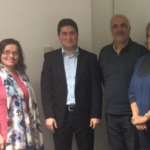
Devasted that Luljeta Nuzi has died after a long fight with cancer. An incredible, dynamic, fierce woman whose optimism and passion for equality for all, in education, as women, as members of refugee and global majority communities will remain an inspiration for those who met her. I first met Luljeta in 2009 when she came […]

To read any news item in more detail, just click on the headline.
Government drops plans to regulate all out-of-school settings
The Department for Education consulted on the regulation of supplementary schools and other forms of out-of-school education over the winter of 2015/16. Many of you responded to this consultation and NRCSE responded also on your behalf.
The results of that consultation have just been published. Over 3,000 organisations and individuals responded directly through the online consultation, a further 15,000 additional responses were received via other methods including emails, letters and online petitions. Of the 3,082 responses to the full consultation document, 1,687 were from faith groups, 604 were from parents and 212 were from out-of-school settings.
We will be summarising the response here but in the meantime if you would like to download it and read through yourself follow this link – DfE consultation on out-of-school settings
There was overwhelming rejection of the proposal to regulate all settings operating 6-8 hours per week.
- Only 4.5% of people had any concerns about any out-of-school education settings they knew of and “Of those respondents who raised concerns, most expressed them in broad terms about out-of-school settings as a whole or the potential for there to be concerns about activities taking place in such settings, while others took the opportunity to express concerns about the impact of the proposed policy to regulate out-of-school settings” (consultation question 13, p6).
- Only 14.4% agreed that the definition of “intensive education” should be six to eight hours a week – the threshold at which it was proposed to register and inspect (consultation question 17, p8).
- Only 14.8% agreed that Oftsed should be able to investigate out-of-school settings that met the government threshold, with 74.6% giving an “No” (consultation question 20).
- In response to the question “What impact do you think the proposed system for registration and inspection will have on out-of-school settings?” (consultation question 21, p11), the published consultation summary states: “Many respondents felt that the impact of the proposed system would limit religious freedoms and have a disproportionately negative effect on faith groups.”
The Department for Education has set aside £3million to run a pilot scheme in 16 local authorities to check the minority of providers that they believe ‘could undermine British values’ and to provide guidance for parents to support them in making informed choices when considering out-of-school settings for their children.
Of course the choices that parents make are informed by the range of supplementary classes available to them. As local authority funding for community organisations continues to be cut, or in many cases has entirely stopped, it is becoming increasingly difficult for community organisations to afford to rent the most appropriate venues, to provide quality training and development opportunities for staff, to employ administrative support, to select diverse teaching resources, etc.
NRCSE will contact all those local authorities to encourage them to use the monies allocated to this pilot to offer training and support to supplementary schools as a positive way of helping communities to deliver specific educational activities that enhance and develop children’s cultural awareness and language skills, build their confidence and academic attainment, support them to be resilient to acts of hate, violence and discrimination.
NRCSE has developed and delivered quality assurance tools over the last 12 years, over 1,000 providers of out-of-school activities from across England have used those tools to evaluate and improve the safety and efficacy of their service. 488 organisations have gone on to obtain an NRCSE Quality Mark (previously Bronze, Silver, Gold or Special Distinction Quality Framework Award). We have unrivaled expertise in this area and have always worked closely with community organisations, supplementary schools, local authorities, the Department for Education and funders to ensure that our quality assurance tools are rigorous and developmental. If you would like to complete our 3-day Good Management course and/or obtain a NRCSE Quality Mark please tell your local authority to get in touch with us.
Government Green Paper on integration
by Schools Week, Alix Robertson – | 13:00, Mar 14, 2018
A raft of measures for schools aimed at improving community integration have been announced by the government.
The Ministry of Housing, Communities and Local Government has today published its Integrated Communities Strategy green paper, which sets out changes to the free schools application process and school admissions arrangements, new rules for private schools and unregistered settings, and guidance on home education. Here are the main proposals relevant to schools.
1. Free school bids must address integration
Future applications to open new free schools will need to explain how they will prepare children for life in modern Britain. Applicants will be required to outline how they will promote fundamental British values of democracy, the rule of law, individual liberty and mutual respect.
They will also need to say how they will attract pupils from different backgrounds and communities, and encourage pupils from different communities, faiths and backgrounds to work together and learn about each other’s customs. The government will publish details for future waves of the free school programme “shortly”.
2. Admissions rules will change in 5 areas to improve diversity
Schools will be forced to admit a more diverse intake of pupils in five “integration areas”: Blackburn with Darwen, Bradford, Peterborough, Walsall, and Waltham Forest.
The government says it will work with councils and schools to help them make intakes “more representative of their wider area”.
Although parents will still get to choose between schools, new admissions arrangements will be developed and catchment areas will be varied to take into account the most diverse communities.
3. Unregistered schools will be more closely monitored
The government will work with Ofsted and local councils to ensure children attending unregistered independent schools and out of school settings are safe and are receiving a suitable education. All full-time independent education settings should be registered and regulated, no matter what curriculum they offer.
The government will change the rules so independent education settings have to register if they have any children attending full-time during the school day. There will be a consultation “in due course” on the details.
Ofsted’s powers in relation to unregistered schools will be also reviewed, to look at strengthening their abilities to collect evidence and interview those suspected of running illegal schools, to meet the stringent requirements for criminal prosecutions and ensure illegal schools close. A Speilman, the chief inspector schs, has expressed frustration at the lack of powers for Ofsted in this regard.
4. Tougher guidance and enforcement for private schools
Two consultation documents designed to improve the existing system for regulating private schools will be published “shortly”.
The first document will include updated guidance on the independent school standards, to help schools understand what they mean and what they need to do to meet them, and clarify the government’s expectations.
The second will set out the circumstances in which the DfE would move to “enforcement action” if a school fails to improve and meet the independent school standards. Proposed new powers include the ability to prevent private schools from recruiting new pupils and force closure.
“We are committed to taking a firmer approach to enforce standards when there is evidence of noncompliance,” the paper said.
5. New guidance on home education
The government wants to crack down on cases where children are said to be “home educated”, but are actually attending an unregistered school setting.
The DfE will revise non-statutory guidance on home education to explain the respective rights and obligations of LAs and parents more clearly, and to make it easier for LAs to “tackle poor elective home education more effectively and with more confidence”. The government will also invite parents and young people to give their views on the revised guidance.
6. Parents must support school leaders’ policy decisions
Pupils’ rights to express their religion or belief may need to be restricted in some circumstances, and schools’ final decisions must be respected by parents, the government said.
Such restrictions “may be justified where a school has good reason”, such as “the promotion of cohesion”. In the recent case of St Stephen’s Primary School in Newham, a ban on young pupils wearing the hijab had to be removed after a backlash from the community. “Pupils have the right to manifest a religion or belief, but not necessarily at all times, in all places or in a particular manner,” the paper said.
School leaders must carefully consider reasonable requests to accommodate religious or other beliefs, but weigh this against the aim of creating a unified school ethos or for the safety of pupils.
“It is for the school to make the final decision and we will not tolerate undue pressure or harassment of school leaders who, having considered requests and consulted on their policies, determine policies that reflects their individual school’s ethos and values.
7. Ofsted will review its British values approach
The schools watchdog will review the prominence and the weight attached to fundamental British values during inspections, making the matter more of a priority.
It will ensure there is “strong coverage of schools’ promotion of fundamental British values and integration” within its new inspection framework, which comes into effect from September 2019.
8. English language strategy
A new strategy for English language learning will be published, including plans for new community-based programmes and local “conversation clubs”.
9. Better data on Roma children
A bid to improve the data held on pupils from a Roma background will help local service providers to “better understand and meet their needs” and clamp down on truancy.
Quality Mark your supplementary school
The NRCSE Quality Mark builds on Section 11 of the Children’s Act 2004 and addresses eight standards in educational provision:
- Create an effective learning environment
- Teach effectively
- Record progress and achievement
- Choose the right resources
- Plan and develop your organisation
- Select and support staff and volunteers
- Make sure that children are safe
- Manage finances
The NRCSE provides free self-evaluation resources and online guidance on minimum safeguarding standards on our website staging.supplementaryeducation.org.uk Downloadable templates and discounted training can be accessed by subscribing to NRCSE. Contact details for agencies providing support in the school’s local authority area are also provided. The NSPCC has recently updated their toolkit of safeguarding standards and guidance in line with Section 11 guidelines so that is a good place to start if your local safeguarding children board isn’t responding quickly. Section 11 of the Children Act 2004 places duties on a range of agencies and individuals to ensure their functions, and any services that they contract out to others, are discharged having regard to the need to safeguard and promote the welfare of children. You can contact your local safeguarding children board to obtain details of the support provided in your area to meet these standards.
In order to apply for an NRCSE Quality Mark a supplementary school must:
- Meet the stated Section 11/safeguarding requirements for the local authority, and
- provide up-to-date information on the services it provides, and
- have received a visit from an appropriate person*.
To check whether you are ready to attend a Quality Recognition Meeting – self-assess your provision here.
Following an NRCSE Quality Recognition Meeting the school will receive a detailed report highlighting good practice and containing recommendations for development. Successful recognition will entitle the school to carry the NRCSE Quality Mark and the quality assurance report will be publicly available on the NRCSE Online Directory of Supplementary Schools (unless the supplementary school has provided a written request not to be publicly listed).
*nationally qualified member of teaching staff (not your school), or Children’s Services, or registered NRCSE quality mentor
Once you have achieved an NRCSE Quality Mark, celebrate!
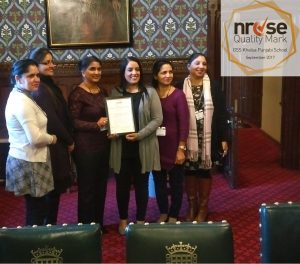
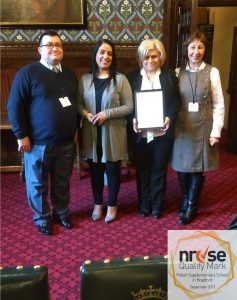
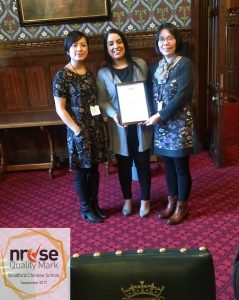
These three Bradford schools asked their MP to invite them to the Houses of Parliament to present their certificates. Naz Shah MP was very happy to do so, see below. They also had a tour, listened to Prime Minister’s Question Time in the House of Commons and had tea and biscuits in fancy Houses of Parliament teacups! Bradford Council also had an event where all the pupils performed and councillors, education staff and families and friends recognised their achievement.
British Museum Community and Supplementary School events
Charmed Lives in Greece
I’m delighted to invite you and your students, teachers and families to an exclusive Community Preview of Charmed Lives in Greece: Ghika, Craxton & Leigh Fermor at the British Museum on Sunday 4th March 2018. The exhibition explores the friendship of the artists Nikos Hadjikyriakos-
Ghika and John Craxton and the writer Patrick Leigh Fermor and how their work was inspired by a shared love of Greece.

We are also inviting schools to take part in the Great Postcard Challenge and have their own artwork, inspired by the exhibition, displayed at the museum on the day. We’d love your school to get involved and have a resource pack we can send you with information on the exhibition and submitting artwork.
To book your tickets* and for information on the resource and postcard challenge please email aross@britishmuseum.org before Monday 12th February
Save the Date – 17th March 2018
As part of British Science Week, we will be organising an exciting day for supplementary schools to explore Science, Maths and history through objects in the museum’s collection. The special event Zoom-in will also be taking place in the museum, where you will be able to explore how science unlocks objects’ secrets, see the latest technology in action and handle raw materials.
More information to follow but if you have any questions in the meantime please contact aross@britishmuseum.org
020 7323 8972
Alice Ross