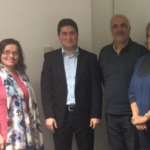
Devasted that Luljeta Nuzi has died after a long fight with cancer. An incredible, dynamic, fierce woman whose optimism and passion for equality for all, in education, as women, as members of refugee and global majority communities will remain an inspiration for those who met her. I first met Luljeta in 2009 when she came […]

Spoken Language Statements
Schools/Colleges and other examination centres have been asked by Ofqual to obtain spoken language statements for private entrants or their own entrants for languages they do not teach. This webinar will support community/supplementary school teachers to provide the spoken language statement and will support mainstream schools to work with supplementary schools to enable them to provide the exam boards with a spoken language endorsement level.
The endorsement level can be provided by a supplementary school or community school, by a private tutor or by a speaker of the language who is not a relative or friend of the student who will act as Assessor.
Does the school/college need to arrange to get an endorsement for any private candidates and any of its own students being entered in a language for which it has no teacher?
Yes. It is the responsibility of the school/college to liaise with the supplementary/community school or private tutor or find a speaker of the language who is not a relative or friend of the student. Ofqual has stated that awarding organisations must require each centre to provide them with a, ‘spoken language statement’, confirming that it has taken reasonable steps to ensure there is an opportunity for an assessment of spoken language for every learner.
To support supplementary school/community teachers in the preparation of Spoken Language Statements and to advice you on how to ensure that your pupils receive a mark for their spoken language NRCSE has invited Pearson EdExcel and AQA exam boards to go through the requirements with you. We will also be joined by key community language champions from the British Council, APPG MFL, ASCL who are all keen to ensure that pupils entering a mother tongue/home/heritage language are not disadvantaged by the changes as they were in 2020.
This webinar is for teachers supporting pupils entered for GCSEs. We hope to include those entered for Cambridge International IGCSEs and O levels. Please check with us.
COVID-19 Update: Out-of-school settings in Tier 4
The government announced on Saturday December 19, that London and some areas of the south east and the East of England have moved into Local Restriction Tier 4 (Stay at Home).
The central local restriction tiers guidance has been updated to reflect what this means for childcare / supervised activities for children (i.e. out-of-school settings) in Tier 4.
Registered wraparound childcare and supervised activities for children, such as out-of-school settings, should only be accessed where the provision is necessary:
- to allow parents / carers to work, seek work, undertake education or training, or attend a medical appointment;
- for the purposes of respite care; or
- where the provision is being used by home educating parents as part of their existing arrangements for their child to receive a suitable full-time education.
The out-of-school settings guidance has been updated to reflect this position in more detail.
January Return
There was also an announcement about mass testing of secondary school students during the first week of term in January. Guidance on what this means for education and childcare settings, including out-of-school settings, was published on Friday December 18: Schools and childcare settings: return in January 2021 – GOV.UK (www.gov.uk)
To support with the mass testing effort, the government is asking that secondary school students receiving remote education from their school during the first week of term in January do not attend out-of-school settings during this time. This means that out-of-school settings and wraparound childcare can continue to operate for face-to-face provision between 4 and 11 January 2021 for children who are:
- home educated
- in early years settings
- in primary school
- in the secondary school-age cohorts eligible for full-time on-site provision – vulnerable children, children of critical workers and those in year 11 and 13
Those of you who are continuing to operate for face-to-face provision during this period should ensure that they make parents aware that their setting should only be accessed if their child is in one of the eligible groups outlined.
| Anne-Marie Mongan | Policy Adviser | Out-of-school Settings, Wraparound, and Integration Unit Email: anne-marie.mongan@education.gov.uk gov.uk | Twitter | Facebook Sanctuary Buildings, 20 Great Smith Street, SW1P 3BT |
Support for community-led out-of-school settings
Adapting to 2020 and preparing for 2021!
We offer guidance, templates, assessment, and management and teacher training online to support safe and effective community-led educational activities for children and young people.
For further information on any of our offers please contact Pascale Vassie or Suzie Yassin
NRCSE delivers lockdown support
For all of you who were unable to attend our AGM on 24 November or who attended our webinar series and asked to see the presentation of what we have been getting up to…
Read our report on how four supplementary schools responded to the coronavirus pandemic.
For information on our events, webinars and to sign up to future courses please bookmark and check our event calendar.
To access support, guidance and templates, early bird invitations and discounts on courses just subscribe to NRCSE.