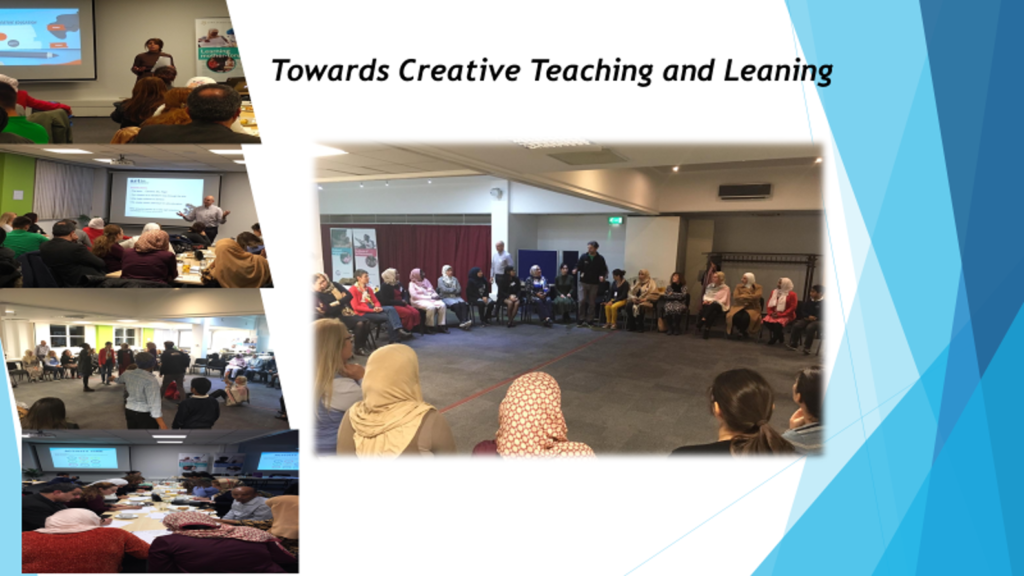
Devasted that Luljeta Nuzi has died after a long fight with cancer. An incredible, dynamic, fierce woman whose optimism and passion for equality for all, in education, as women, as members of refugee and global majority communities will remain an inspiration for those who met her. I first met Luljeta in 2009 when she came […]

Main updates to the guidance for out-of-school settings during Covid19 pandemic
The Department for Education’s guidance for out-of-school settings who provide activities for children, was updated on 23 February 2021.
It can be read in full on the www.gov.uk website and applies to all forms of:
- community activities
- tuition
- holiday clubs
- breakfast and after-school clubs for children
Until Monday 8th March ·Out-of-school settings and wraparound childcare providers should continue to offer indoor or outdoor provision ONLY for: vulnerable children and young people and children of critical workers, where the provision is reasonably necessary to enable their parents and carers to work, search for work, undertake education or training, or attend a medical appointment or address a medical need
Position from Monday 8th March – out-of-school settings and wraparound childcare providers will be able to offer indoor and outdoor provision to all children. However, parents and carers will only be able to access your settings for certain essential purposes. Therefore, from 8th March, providers should only offer indoor and outdoor face-to-face provision to: vulnerable children and young people, other children, where the provision is:
- reasonably necessary to enable their parents and carers to work, search for work, undertake education or training, or attend a medical appointment or address a medical need, or attend a support group
- being used by electively home educating parents as part of their arrangements for their child to receive a suitable full-time education; or
- being used as part of their efforts to obtain a regulated qualification, meet the entry requirements for an education institution, or to undertake exams and assessments.
When schools close for the Easter/Spring holidays (from 29 March) – out-of-school settings and wraparound providers will be able to offer:
- outdoor provision to all children, without restrictions on the purpose for which they may attend
- indoor provision to: vulnerable children and young people; children on free school meals, where they are attending as part of the DfE’s Holiday Activities and Food Programme; other children, where the provision is reasonably necessary to enable their parents and carers to work, search for work, undertake education or training, or attend a medical appointment or address a medical need, or attend a support group; or is being used by electively home educating parents as part of their arrangements for their child to receive a suitable full-time education; or is being used as part of their efforts to obtain a regulated qualification, meet the entry requirements for an education institution, or to undertake exams and assessments.
Summer term and beyond
The Government’s intention is then for out-of-school settings and wraparound childcare providers to be able offer provision as normal, to all children, from the start of the school summer term. This will be no earlier than 12 April, and will be confirmed as part of Step 2 of the COVID-19 Response – Spring 2021.
NRCSE will be running webinars on the updated protective measures that must be in place to re-open and continuing with our programme of remote training to support community teachers to deliver:
- remotely and online;
- return to face-to-face with an awareness of the interruptions and stresses children have been facing in their mainstream schooling; and
- blended learning to enable you to give support appropriate to each age group.
Bookmark our events page to remind you to check when webinars and courses are happening so you can book your place.
How GCSE, AS and A level grades should be awarded in summer 2021
How the proposed arrangements for 2021 differ from those used in a normal year and those used in 2020. The information below is taken from the government website.
The consultation is now closed and we are waiting for confirmation of the arrangements, particularly the arrangements for students taking home / heritage languages outside their mainstream schools.
Students who had been expecting to take exams will wish to understand how our proposed approach will be different to that of a normal year. The table below summarises the normal arrangements and the proposed alternative arrangements for 2021.
| Aspect | Normal year | Proposed approach for 2021 | Comments |
|---|---|---|---|
| Exams | Students take ‘unseen exams’ – neither they nor their teachers know beforehand the topics to be covered by the questions. All students take the same exam papers. The exams are taken under tightly controlled conditions. The exams are marked by the exam boards. | There will be no exams (except perhaps in the case of private candidates). | The experience should be less daunting for students. The exact arrangements will be decided following the consultation and will have to take account of any public health restrictions in place at the time. |
| Non-exam assessment | Non-exam assessments are used in some subjects. They are usually marked by teachers and the marking is moderated by the exam boards. The relative weighting of the exam(s) and non-exam assessment is prescribed. | We propose that non-exam assessment is completed where possible, although the conditions under which they are taken might have to be relaxed. We propose that the exam boards do not moderate teacher marking. Teachers should be able to reduce the normal weight given to non-exam assessment, if a student has had difficulties completing it. | In some subjects non-exam assessments do not require any specialist equipment and can be undertaken when students are not in school or college. Non-exam assessments will be more difficult to complete in other subjects. |
| Evidence of a student’s performance | The only evidence taken into account when a student’s grade is set is their performance in their exams and non-exam assessments. | We propose that teachers will be able to take into account other evidence of a student’s performance. We propose the exam boards should provide guidance on the relative weighting of the different forms of evidence. This may include the use of papers set by the exam boards, evidence from non-exam assessment or other performance evidence. It may also include student performance in papers prepared by teachers. | The proposals will allow teachers to make a holistic, evidence-based assessment of the grade each student should receive. |
| Appeals | Schools and colleges can ask for the marking of an exam to be reviewed, after results have been issued. Students can ask their school or college to review a teacher’s marking of their non-exam assessment before the mark is submitted for moderation. | We propose that students should be able to appeal on the ground that the grade is not supported by the evidence of their performance or followed the correct approach. We are looking at the timing of results day to increase the time available for the appeals process. | If this proposal is taken forward it will allow a number of appeals to be resolved before results are issued. |
| Setting standards | The exam boards set grade boundaries. In this way they maintain standards year on year, between schools and colleges and between exam boards. | As exams have been cancelled, exam boards will not be able to set grade boundaries. Teachers will instead submit to the exam board the grade they think a student’s performance deserves based on the standard of the student’s work, and in line with the training and guidance provided for assessment. | Standards will be protected to a degree if teachers take evidence-based decisions in line with the exam boards’ requirements. The usual assurances of comparability between years, between individual students, between schools and colleges and between exam boards will not be possible. |
This is the second year in which the government has taken the difficult decision that, because of the coronavirus (COVID-19) pandemic, GCSE, AS and A level exams cannot take place fairly.
The timing of the decision and the context in which it was taken are different this year. Our proposed approach to awarding grades in 2021 is also different, taking into account the current context and the lessons learned from 2020.
We have been approved for CLEx!
The power of partnership!! Feeling so positive about what we have achieved together with Nuriye Mertcan, Turkish Language Culture & Education Consortium, Vicky Gough, British Council Arabic Language and Culture Programme with QFI and Pearson.
NRCSE has established the Community Language Examination Centre, CLEx, to enable more students to achieve a qualification in their home or heritage language. In 2020, 1,000s of young people were withdrawn from entering the language qualification they had studied so hard for. In January 2021, when the government announced that summer exams would again be cancelled, the same thing started to happen. Mainstream schools were reluctant to enter their own students for subjects they were not studying in the mainstream school and refused to enter private candidates altogether.
For this reason, working with Pearson, we created a partnership with Turkegitim Konsorsiyomu and the British Council to become CLEx, an approved examination centre for community languages.
We have also been campaigning with the APPG for Modern Foreign Languages, the Association for School and College Leaders and colleagues across the secondary languages area to request that Ofqual consider carefully the situation facing young people studying home or heritage languages. Already an extension to the entry deadlines has been given and students have a further 4 weeks to register. Entry deadline is now 21st March. We await the considered response to the public consultation about how GCSE and A level grades should be awarded this year and what support will be given to ‘private’ candidates.
If you have students in Yr 10 and above who are ready to take their GCSE or A level in Turkish or Arabic and have been unable to find a centre to accept them – we can help. See the slides below and get in touch with the examination team at CLEx exams@nrcse.org.uk
Championing community-led learning
NRCSE Executive Director has written two pieces for Languages Today – the magazine for MFL language teachers in primary and secondary. Together with the important support we are receiving from Baroness Coussins and colleagues on the All Party Parliamentary Group for Languages, we are seeing increasing awareness from mainstream of the role of community teachers and the importance of community-led learning of home and heritage languages.
The full article is available on the All-Languages website and our piece on creativity in community settings also Languages Today Extra: Rising to the challenge – community-led learning during the Covid19 pandemic – Association for Language Learning (all-languages.org.uk)
Discover more about the creativity and passion of community teachers on our project pages and in the lockdown delivery research we undertook in October 2020. With thanks to Dr Mon Partovi and Akhita Benjamin.