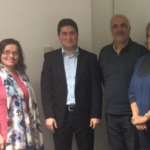
Devasted that Luljeta Nuzi has died after a long fight with cancer. An incredible, dynamic, fierce woman whose optimism and passion for equality for all, in education, as women, as members of refugee and global majority communities will remain an inspiration for those who met her. I first met Luljeta in 2009 when she came […]
April 15-17 Language rules? Languages, standards and linguistic inequality: multilingualism and variation in education, law and citizenship
Save the Date! (Registration from late January 2019)
Language rules? Languages, standards and linguistic inequality: multilingualism and variation in education, law and citizenship
University of Nottingham, April 15-17, 2019
As part of the AHRC-funded project Multilingualism – Empowering Individuals, Transforming Societies (www.meits.org), Language Rules will bring together practitioners – teachers, speech therapists, examiners, dictionary-makers, lobbyists, policy-makers, and others – with academics to examine how assumptions about correct, acceptable or standard languages impact on everyday life in a multilingual world, and how to tackle potential inequalities.
The conference includes a public Leverhulme Lecture by the Leverhulme Trust Visiting Professor at the University of Nottingham, Professor Doug Kibbee:
• Professor Doug Kibbee – Language, Law and Linguistic Inequality in the USA and Europe
Other confirmed keynote speakers:
• Brian North – Language standard, plurilingual repertoires and the Common European Framework of Reference for Languages (CEFR)
• Prof. Bettina Migge (University College Dublin) – (In)visible Languages and Equality, Diversity and Inclusion
• Prof. Astrid Adler (Institut Deutsche Sprache, Mannheim) – European Language Policies
Confirmed panels include:
• Language standard, standard languages, and speech therapy
• Multilingualism, language standards, and the law
• Language examinations and language standards
• Learning from history – understanding the multilingual past to inform the present
• Languages and Equality, Diversity and Inclusion
• Translating Research Into Policy
The Nottingham launch of We are Multilingual will also take place as part of the event.
For queries, please contact Nicola.mclelland@nottingham.ac.uk
Prof. Nicola McLelland
Professor of German and History of Linguistics
Head of School
School of Cultures, Languages and Area Studies
University of Nottingham
Room B6a, Trent Building
University Park
Nottingham, NG7 2RD
+44 (0) 115 95 15822 | nicola.mclelland@nottingham.ac.uk .ac.uk
http://www.nottingham.ac.uk/clas/people/nicola.mclelland
Follow us
Facebook.com/TheUniofNottingham
Twitter.com/UniofNottingham
Youtube.com/nottmuniversity
Instagram.com/uniofnottingham
Linkedin.com/company/university-of-Nottingham
Co-Investigator and Deputy Project-Leader, on the AHRC-funded MEITS project (2016-2020): www.meits.org
Latest books:
The History of Language Learning and Teaching, ed., with Richard Smith, (3. Vols. Legenda, for the MHRA, 2018)
The CARAF Centre Black History and Science Teachers Vacancy
NRCSE Member Association job vacancies
THE CARAF CENTRE
REQUIRES
Black History and Science Teachers for
Mandela Supplementary School
We are currently seeking teachers for our Saturday School classes – 1 hour sessions between 10 am-1.30 pm.
The successful applicants will work with children aged 5 to 11 years old. A strong educational background and a very positive outlook are essential requirements to motivate pupils in Key Stages 1 & 2. Our motto is “Learning is Fun”.
Job type: Term time only
Starting date: 12th January 2019
If you would like to know more about this role please contact:
The Caraf Centre, 27-30 Cheriton, Queen’s Crescent NW5 4EZ
Mandela School Co-ordinator on 0207 284 0030 Ext: 207
E-mail: mandela@thecarafcentre.org.uk
Website: www.thecarafcentre.co.uk”
Quality Mark Briefing – for educational experts and local authorities
Since 2009, the National Resource Centre for Supplementary Education has supported 500 supplementary schools to develop the quality of their provision through training, facilitation and moderation of nationally recognised and respected quality assurance for the supplementary education sector that:
- raises awareness,
- improves quality, and
- facilitates partnership
To achieve a Quality Mark, supplementary schools must demonstrate that they:
1. Create an effective learning environment
2. Teach effectively
3. Record progress and achievement
4. Choose the right resources
5. Plan and develop your organisation
6. Select and support staff and volunteers
7. Make sure that children are safe
8. Manage finances wisely
There are three routes to ensure good practice is being met and to access the NRCSE Quality Mark.
1. Supplementary schools are supported by a trained mentor or local authority representative who checks that they are meeting local and national safeguarding standards and completes the NRCSE management checklist report.
2. Groups of supplementary schools take the NRCSE 3-day Good Management course and are each supported to complete a management folder. The NRCSE management checklist report is completed by an NRCSE Quality Development Adviser (generally the course trainer)
3. An individual supplementary school completes online assessment of their provision and upload copies of policies and procedures. An NRCSE Quality Development Advisor checks through their documents and gives feedback via the NRCSE management checklist report.
Once safeguarding standards are met the school downloads templates and guidance from the NRCSE website and prepares a portfolio of evidence. The school must arrange an observation visit from an appropriate person (qualified teacher/education professional/NRCSE-trained mentor) who will write a short report witnessing what they have observed. The school then confirms that they are ready for their provision to be quality assured by NRCSE.
NRCSE will discuss with the school and local authority to identify a local ‘educational expert’ and arrange for a ‘Quality Recognition Meeting’ to take place.
At the Quality Recognition Meeting, two experts (one from a mainstream educational background and one from NRCSE) will scrutinise the portfolio of evidence, listen to a short presentation from school representatives, ask questions, and come to a decision as to the level at which the eight standards have been achieved.
A Quality Mark report is prepared, together with a certificate and a logo and sent to the school.
With the school’s permission, this report is included on NRCSE’s online directory of quality supplementary education providers.
Local authorities are encouraged to publicise the achievement of supplementary schools in their area, demonstrating their own good practice and supportive response to government regulation and statutory guidance.
NRCSE aims to arrange a national celebration of achievement annually. Past celebrations have taken place at the British Museum and the Houses of Parliament.
Parenting Programme in Hammersmith & Fulham
Edith Durham Supplementary School in Hammersmith & Fulham organising Parenting Programme on one Friday of each month.
NRCSE is kindly passing the details of the programme on behalf of Durham Supplementary School. Please see below more information about Parenting Programme.
Dear All,
Please let me know if you are interested in Parenting Programme. The Next session will be on 23 Nov: Time: 11am-1pm
FREE PARENTING PROGRAM @ Edith Durham Community – Free Lunch provided!
Children Growth Development
In this topic we will be teaching what parents and carers need to know about the four key stages of development: physical, cognitive, emotional and sexual development. This will ensure they are informed about the specific changes kids will go through and how to cater to their progression.
Children’s Behaviour
Here, the developmental changes to children’s temperament will be taught and the different ways a parent or carer can go about dealing with the child’s behaviour. We will also advise upon the qualities a parent should possess in keeping a parenting method that allows for a healthy household where the child can feel consistency which improves bad behaviour.
Parenting Stress
This topic builds upon the previous topic in the way of coping with the stresses of tending to children and the ways to cope with these issues. The qualities mentioned previously will be developed with more clarity and we will explain the pros and cons between them.
Health and Safety
In this topic, we will be teaching the fundamentals of health and safety around children. Areas such as food preparation, danger-free environments and hygiene will be taught. Also, a demonstration about how to effectively go about these practical subjects will be performed also to further develop the understanding of parents.
Venue:
St. Mary’s Church, 2 Edith Road, West Kensington, W14 9BA
Dates and Times:
Session 1: 26th October 2018 11am-1pm
Session 2: 23rd November 2018 11am-1pm
Session 3: 14th December 2018 11am-1pm
Session 4: 18th January 2019 11am-1pm
Graduation ceremony: 15th February 2019 11am-1pm
Kind regards,
Mirjeta
Edith Durham Community
Tel: 07882855377