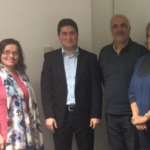
Devasted that Luljeta Nuzi has died after a long fight with cancer. An incredible, dynamic, fierce woman whose optimism and passion for equality for all, in education, as women, as members of refugee and global majority communities will remain an inspiration for those who met her. I first met Luljeta in 2009 when she came […]

Latest stats for ‘lesser-taught’ languages
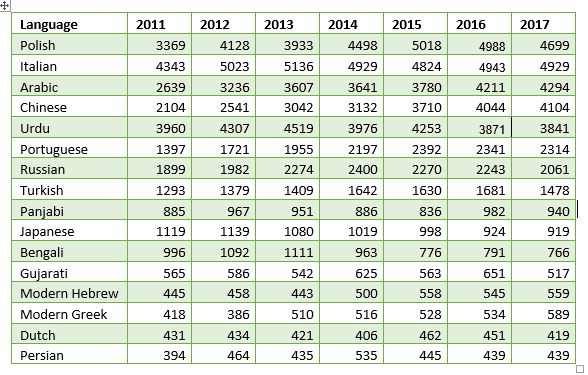
The wonderful Teresa Tinsley, who writes Language Trends each year and is a champion for language learning, has prepared this chart for us.
Showing entries for GCSE and A level examinations in all 16 languages that currently have GB exams available, the chart also shows trends in the numbers entering those exams since 2011.
You will remember that we all had to campaign very hard in 2016 to retain the range of languages with an GB exam available. Working together we were successful in convincing Pearson Edexcel to take over exams that were due to be shelved.
But the hard work has only just begun.
The new exams are being developed now, they will be available for teaching next year and for examination the year after. We need to ensure that teachers are properly trained to teach the new syllabus, we need to ensure children can be presented for those exams in their mainstream schools or join together in language communities to offer centralised examination centres in the way the Tamil community has done. And you need to convince your pupils and their parents to continue their language education so that they can take the exams.
Here are the GCSE entries, you can check A levels on Teresa’s blog
Two research studies published
Two leading think-tanks, IPPR and RSA, publish reports on supplementary schools
From Institute for Public Policy Research
Satu
rdays for success: How supplementary education can support pupils from all backgrounds to flourish
Mainstream schools can benefit in a number of ways from the work of the UK’s many community-led educational programmes. This report makes recommendations for how more pupils, schools and communities can gain from the rich, extracurricular learning environments that these ‘supplementary schools’ offer.The more diverse Britain becomes, the more scope there is for mainstream schools to take advantage of, and benefit from, the extensive network of between 3,000 and 5,000 supplementary schools that exists in the country. These community-led out-of-school educational programmes, set up largely by migrant and ethnic minority communities, have widespread support from parents and communities, and offer a personalised and informal learning environment that complements mainstream education, covering areas including the core curriculum, languages, and cultural activities.
At their best, these supplementary schools offer children and young adults a rich learning experience, providing personalised learning with strong pupil–teacher engagement, and giving young people the means to explore complex questions of identity, engage with role models from similar backgrounds, and develop networks of peer support.
In this report we recommend greater complementarity and coordination between the mainstream education system and these thriving supplementary schools. This would make some mainstream schools better prepared and equipped to deal with the pressures that come with catering for a diverse student body, and further the government’s commitments to community- and parent-led approaches to education, and to greater diversity and autonomy within the schools system.
We call for more mainstream schools to, through engagement with supplementary schools, become active players in their communities. In doing so, they can raise the capacity of those communities, and of parents, to take ownership over their children’s education. They can help ensure that out-of-school learning and enrichment opportunities are high-quality, and open and accessible to all pupils, particularly those who need them the most.
 This report sets out a roadmap for how mainstream schools can build on and engage with supplementary education, where there is a high-quality local offer. We suggest three modes of engagement with supplementary schools:
- mapping supplementary school uptake
- greater coordination with, and referral to, supplementary schools
- cooperative programming with supplementary schools.
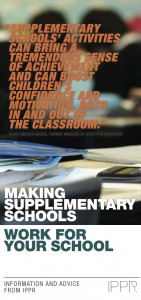
Making supplementary schools work for your school
IPPR has also produced a summary of the research presented in this report, tailored specifically for headteachers and other education professionals in primary and secondary schools.
Entitled ‘Making supplementary schools work for your school’, it considers the challenges facing mainstream schools, asks how those schools and their pupils can benefit from supplementary schools, and suggests how they can best work together.
You can download it here.
And from the RSA (Royal Society for the encouragement of Arts, Manufactures and Commerce) Beyond the school gates
 As part of the RSA-Investigate-Ed series, Selina Nwulu explores the developing roles and connections of supplementary schools, in light of the changing needs of black and minority ethnic (BME) pupils and the longstanding barriers they face.
In a changing cultural, social and economic climate, we consider how supplementary schools might adapt, particularly to helping their pupils make successful transitions from school to further and higher education and employment. Over the past 20 years, BME students have made advances within the education system. Chinese and Indian students remain consistently high achievers and Bangladeshi and Nigerian students now outperforming their white British peers at GCSE. Black Caribbean pupils have made some academic advances, but they still attain below the national average. BME students are also far more likely to go to university than they were 20 years ago.
However, beyond compulsory education, the obstacles continue; BME students are less likely to be offered a place at a Russell Group university than their white peers with similar grades. Black, Pakistani and Bangladeshi groups twice as likely to be unemployed as their white peers. By extension, people from BME backgrounds are more likely to work in temporary or precarious employment which has been linked to lower wellbeing.
While supplementary schools cannot and should not address these complex issues alone, how might supplementary schools form a more integral part of the local learning ecology, connecting with mainstream schools, higher and further education institutions and arts and cultural bodies to offer a strengthened network of support to BME young people?
Our report aims to widen the conversation about supplementary schools and their existing roles, so that they are able to evolve with support and intention, This report’s recommendations, therefore, centre on how supplementary schools can harness their strengths to broaden their purpose, connection, impact and sustainability.