Devasted that Luljeta Nuzi has died after a long fight with cancer. An incredible, dynamic, fierce woman whose optimism and passion for equality for all, in education, as women, as members of refugee and global majority communities will remain an inspiration for those who met her. I first met Luljeta in 2009 when she came […]

Languages TedX: A series of short presentations on languages and policy
On 15 July 2021, Pascale Vassie, Director, National Resource Centre for Supplementary Education (NRCSE) presented CLEx at the APPG on Modern Language TedX: A series of short presentations on languages and policy.
The new Community Language Examination Centre (CLEx) is enabling more students to achieve a qualification in their home or heritage language.
Agenda:
1. An update on legislation and languages: Baroness Coussins, Co-Chair of the APPG on Modern Languages
2. An update from GCHQ on cross-government language activity: GCHQ
3. The new Civil Service Languages Network: Hugo Griffin and Matthew Brown, founders
4. The 2021 Language Trends survey of primary and secondary schools in England: Ian Collen, Queen’s University Belfast, lead author of the report
5. Established in February 2021, the new Community Language Examination Centre (CLEx) is enabling more students to achieve a qualification in their home or heritage language: Pascale Vassie, Director, NRCSE
NRCSE Creative Teaching and Learning Project
NRCSE invites you to join our exciting and innovative NRCSE towards Creative Teaching and Learning Project (CTL)
CTL will focus on the role that arts and cultural learning plays in transforming the lives of young people. Our overall aim is to support supplementary schoolteachers to adopt more creative approaches to their classroom practice.
Spaces are very limited, for 22 teachers and ideally 2 teachers working with 7-11 year-old from each setting.
The project is funded by John Lyon’s Charity and includes a small admin fee for participation. Our CTL project partner is Patrice Baldwin, who was the President of the International Drama and Theatre Education Association, a previous Chair of National Drama and Theatre Educators, and the National Director of D4LC.
Thank you for your interest. Remember that places are limited, so please get in touch with Dr Mon Partovi (mon@nrcse.org.uk) to enquire about eligibility.
Update on Out-of-School Settings following PM Announcement
Following the PM’s announcement on Monday 5th July 2021, the out-of-school settings guidance to reflect Step 4 of the roadmap out of lockdown has been updated.
The updated guidance is available at the usual links (see below). You’ll notice that there are two versions of the guidance on each page. One of the guidance documents is the current Step 3 guidance, which you should follow whilst we are still in Step 3. And then the other is the new Step 4 guidance which you should follow when Step 4 commences (due to be 19th July) entitled “COVID-19: Actions for out-of-school settings (applies from Step 4)”.
- Protective measures for holiday or after-school clubs and other out-of-school settings for children during the coronavirus (COVID-19) outbreak – GOV.UK (www.gov.uk)
- Guidance for parents and carers of children attending out-of-school settings during the coronavirus (COVID-19) outbreak – GOV.UK (www.gov.uk)
Main Updates to the Out-of-school Settings Guidance from Step 4
- We will no longer advise that children are kept in consistent groups (“bubbles”). Groups can still be of any size.
- Residential visits may take place in groups of any number at Step 4. However, we are still advising that out-of-school settings do not go on any international visits until the beginning of the new school term in autumn.
- From 16 August 2021, children under the age of 18 years old will no longer be required to self-isolate if they are contacted by NHS Test and Trace as a close contact of a positive COVID-19 case. Instead, children will be contacted by NHS Test and Trace, informed they have been in close contact with a positive case and advised to take a PCR test.
- From Step 4, face coverings will no longer be recommended to be worn in either classrooms or communal areas. They will also no longer be required to be worn in community premises (e.g. village halls, community centres, etc) or on public transport.
- We will no longer advise that you limit the attendance of parents and carers during sessions.
- Parents will no longer need to limit the number of settings their child attends
COVID-19 Safe Re-opening of OOSS Webinar
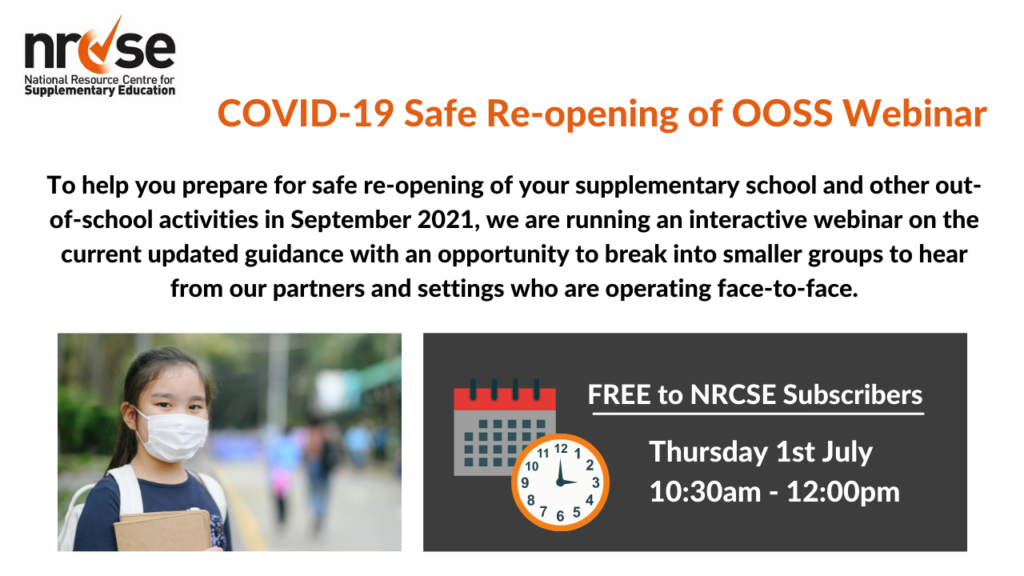
Interactive information session on the safe re-opening of out-of-school settings and supplementary schools based on current government guidance. FREE to NRCSE subscribers.
Sign up via the Eventbrite link: https://www.eventbrite.co.uk/e/covid-19-safe-re-opening-for-out-of-school-settings-tickets-160201118859
We offer regular updates and guidance sessions online free-of-charge to subscribers. As a charity we are dependent on subscriptions and fees to deliver and develop our services for the sector. If you do not wish to subscribe you are welcome to attend our sessions for a small fee of £25
The Department for Education’s guidance for out-of-school settings who provide activities for children, was updated to reflect Step 3 of the roadmap out of lockdown (from 17 May).
The updated guidance is available at:
Indoor Group Sizes
From 17 May, in line with the commencement of Step 3 of the roadmap, we are no longer recommending a specific limit on group numbers indoors. Instead, when you are considering appropriate group sizes, you should take into account factors such as the recommended occupancy levels of the premises you are operating from and levels of ventilation. See the provider guidance for more information.
Parental Attendance at Settings
We continue to advise that parents and carers should not routinely be present during sessions in out-of-school settings due to the potential increased risk of transmission of COVID-19.
Where parents do attend a session, you should consider the ability to maintain social distancing, levels of ventilation, and the recommended occupancy levels of the premises you are operating from.
These factors may mean that you are unable to accommodate or have to limit the number of parents and carers that are present during a session.
Face Coverings in Schools/ FE Colleges
This will only be relevant to those of you who operate from a school/ FE premises.
From 17 May, in line with Step 3 of the roadmap, face coverings will no longer be recommended in classrooms and in all communal areas for children in year 7 and above.
Face coverings will also no longer be recommended for staff in classrooms.
We continue to recommend that face coverings should be worn by staff and visitors in situations outside of classrooms where social distancing is not possible (for example, when moving around in corridors and communal areas).
NB: any further updates in government guidance will be included at the information session.